Tetra Brass Set to Release Debut Full Album
Tetra Brass’ debut album “METALL”: Works of Leoš Janáček · Claude Debussy · Anton Simon
Release Date: March 28th 2025 on the simoc records label

After three EPs, the Munich brass quartet Tetra Brass is finally releasing its debut album! In 21 miniatures, the four musicians explore the sound of the material they work with every day: Metal. A wealth of sounds is revealed in the small works by Leoš Janáček, Claude Debussy, and Anton Simon. “We want to present all the characteristics of our brass instruments on our debut album. The wide range of what we can play with them is often incredibly underestimated,” says Christian Traute, who also writes the arrangements for the quartet.
On METALL, Tetra Brass takes on works from 25 years around 1900. “On our album, we looked for the big picture in small pieces: From the original literature to the combination of old and new in Debussy and finally the compositions by Janáček that point far into the 20th century,” says Christian Traute. The only difference is that the order on the album is exactly the opposite, starting with Janáček’s ‘Auf verwachsenem Pfade’. Initially consisting of just five short pieces for harmonium, the Czech composer (1854-1928) later rewrote them for piano and added a further five works to his cycle by 1908. He was unsuccessful for a long time in his search for a publisher and was not taken seriously as a composer from the countryside in the Prague music scene. He published his work in 1911, and it was not until 1942 that a further five movements were added posthumously.
Janáček wrote the piano cycle after the death of his daughter, which is why it was perceived by many as sombre – today it fascinates as a ‘diary’ of Janáček’s innermost emotional worlds. The version for brass quartet presented here by Tetra Brass allows Janáček’s piano cycle to shine once again in different colours – and the careful use of electronics in selected movements expands the boundaries of the wind sound. You can clearly hear the quartet’s love of experimentation and their desire to interpret classical chamber music works in a completely new way. The arrangement retains the chamber music quality, but Christian Traute’s arrangement was modelled on larger-scale works by Janáček, such as the Glagolitic Mass or the Sinfonietta.
Claude Debussy completed his ‘Trois Chansons de Charles d’Orléans’, composed for vocal ensemble, around the same time as Janáček completed his work ‘Auf verwachsenem Pfade’ – 1908. Debussy (1862-1918) drew on medieval texts by Charles d’Orléans, but at the same time his harmonies have an impressionistic feel. This mixture of Renaissance song techniques and the use of old Romantic texts was a trend at the time the composition was written. In his Trois Chansons, Debussy also adopts the counterpoint technique from the Renaissance, which he himself once described as ‘smiling counterpoint’.
While Debussy and Janáček wrote modern and pioneering music of the 20th century, the French composer Anton Simon (1850-1916), who lived in Russia, moved in a conservative direction, inspired by his great role model Tchaikovsky. Among the ‘22 Petits Morceaux d’ensemble op. 26’ are the only original works for brass quartet on the album. The 22 marches, dances and character pieces are written for ensembles of various sizes, from quartet to septet – the album features Nos. 1-8 for wind quartet.
The fact that Simon composed these works was primarily due to the great popularity of brass music in Russia. This developed from courtly culture: court horn ensembles, usually consisting of at least 15 musicians, were very popular from the middle of the 18th century. Although the court brass culture declined in the course of the 19th century – during Simon’s lifetime – the music continued to enjoy great popularity. In 1888, the first brass quartet was formed in Moscow, founded by musicians from the Bolshoi Theatre. Despite being categorised as music for outdoor events – as the titles of the movements suggest – the 22 Petits Morceaux contain virtuoso passages for the cornet that may sound simple and easy to play, but are quite demanding for musicians.
With METALL, the four musicians of Tetra Brass offer listeners a great opportunity to explore the diversity of their brass instruments – and hopefully, above all, to enjoy them.
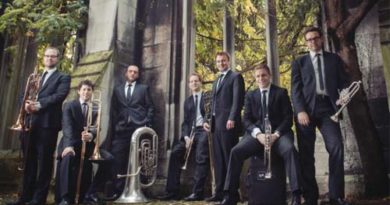
Tetra Brass
Luca Chiché | Trumpet
Aljoscha Zierow | Trumpet
Christian Traute | Trombone
Jakob Grimm | Basstrombone
Founded in 2018, the brass quartet Tetra Brass is celebrated for its warm, refined sound, energetic performances and innovative programming in concert halls such as the Wigmore Hall London, the Philharmonie Berlin, the Solti Hall Budapest, Santa Croce Florence, the Bern Conservatory, the Lindeman Hall Oslo, the Reitschule Grafenegg and the Isarphilharmonie Munich.
Tetra Brass has performed at the Grafenegg Festival, the Detect Classic Festival, the Wege durch das Land Festival, the Mizmorim Chamber Music Festival and the Eigenzeit Festival of the Duisburg Philharmonic Orchestra with programs especially designed for the concert venues.
The ensemble appeared on radio broadcasts at WDR 3, BR Klassik and BBC radio 3.
In the 20th Chieri International Competition (Italy), Tetra Brass was awarded the 1st prize “Primo Premio Assoluto” with the highest possible score. The ensemble received further 1st prizes in international competitions at the II International Viennese Spring Music Competition, the IMC – International Music Competition Paris, the 7th Rising Stars Grand Prix – International Music Competition Berlin and the VRŠAC International Chamber Music Competition (Serbia). In 2023, the ensemble was awarded the Förderpreis für Musik der Stadt München.
As a member of the European Chamber Music Academy (ECMA), Tetra Brass is part of a network in shaping the future world of classical music, based on the great European chamber music traditions. The four musicians have had the privilege to work closely with Hatto Beyerle, Minna Pensola, Johannes Meissl, Karla Haltenwanger and Patrick Jüdt. The quartet studied chamber music with Raphaël Merlin and Reto Bieri at the University of Music and Performing Arts Munich. At the FHNW Basel the musicians deepened their skills in the interpretation of contemporary chamber music with Mike Svoboda and Marcus Weiss.
As an ambassador for Buffet Crampon, Tetra Brass plays exclusively on instruments by Antoine Courtois.
Source: Kristina Patzelt